

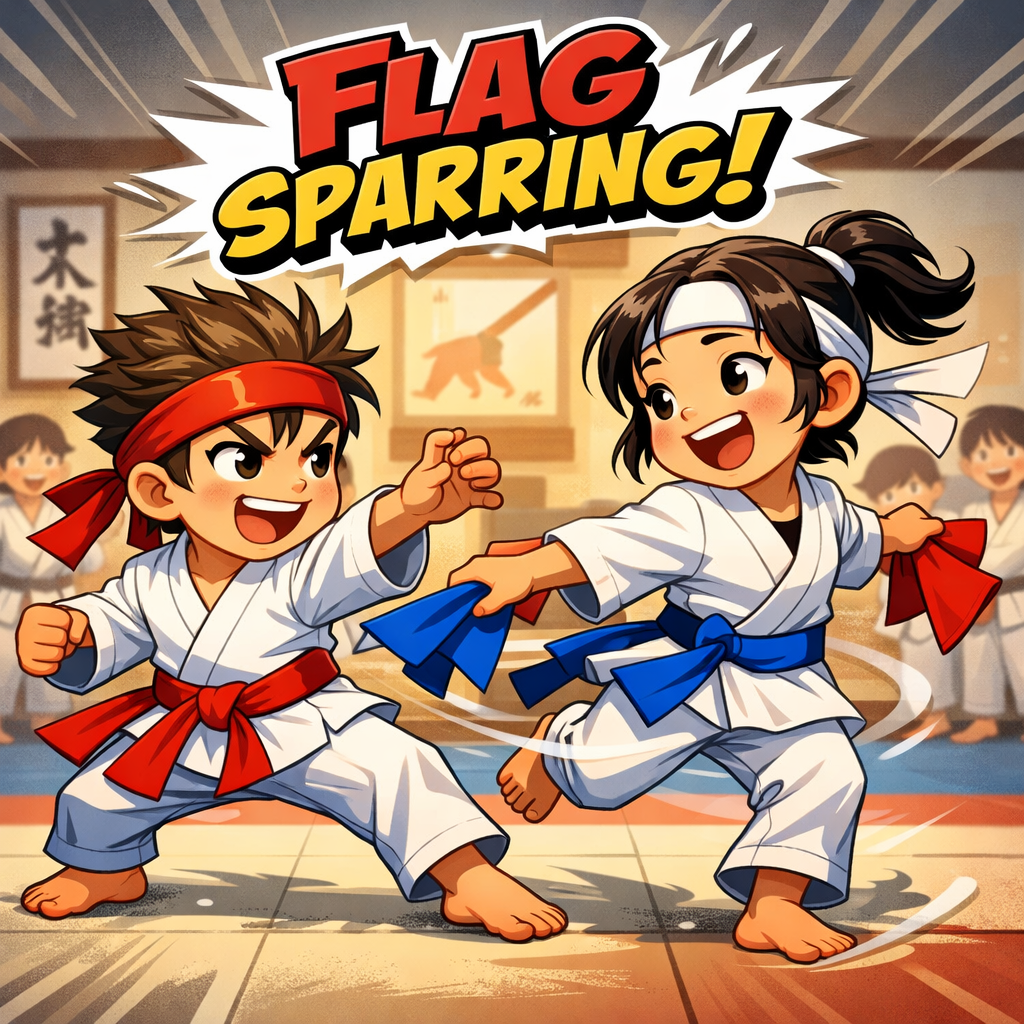
Flag Sparring (think flag football meets martial arts)
is a non-contact, beginner-friendly version of sparring.
Instead of scoring points by striking an opponent, competitors attempt to grab a flag attached to their opponent’s belt.
Each competitor as 4 flags. Whoever has the most flags after 1 minute 30 second round wins.
In the case of simultaneous flags in sudden victory, it is judgement call to re-attach flags for another round.
Each competitor wears a belt with flags tucked into it.
The goal is to pull the opponent’s flag(s) without being tagged yourself.
Matches are usually timed (2-minutes).
The athlete with the most at the end wins.
There are no punches or kicks to the body or head — it’s focused on:
Movement
Footwork
Distance management
Reaction time
Agility
This type of sparring is one of the most electric youth divisions at events like Kumite Classic — and it’s easy to see why.
Instead of striking for points, competitors wear belts with four targets attached, and the goal is simple:
👉 Pull your opponent’s before they pull yours.
It’s fast. It’s strategic. It’s pure excitement.
This type of sparring combines:
Tag
Capture-the-flag
Martial arts footwork
Kids feel like they’re playing — but they’re actually developing serious athletic skills.
At Kumite Classic, when the ring fills up and the crowd leans in, it becomes high-energy and electric.
Flag sparring teaches:
Timing
Angles
Distance control
Reaction speed
Deception & feints
You can’t just charge forward — you have to think.
For young competitors, it’s like chess at 100 mph.
One big reason kids love it:
There’s no striking to the head or body.
That means:
Beginners feel comfortable
Parents feel confident
Kids compete without hesitation
It removes intimidation while keeping intensity.
Matches are explosive.
One second you’re squared up…
The next second — SNAP — the flag is gone.
That instant result keeps kids locked in.
And at a big-stage event like Kumite Classic, that fast pace keeps spectators cheering.
For many young martial artists, flag sparring is:
Their first competition
Their introduction to tournament pressure
Their first podium moment
It builds confidence before moving into traditional kumite.
Even though it looks like a game, it develops:
Footwork like boxing
Angles like karate
Explosiveness like wrestling
Defensive awareness
At a large-scale event like Kumite Classic:
The energy is high
The divisions are packed
Coaches are loud
Parents are cheering
Medals are shining
This non-contact sparring becomes a highlight division — especially for youth athletes.
Because it’s:
Competitive without being scary
Skill-based but playful
Fast-paced and fun
A confidence builder
They leave feeling like champions — even before the medals.

© 2025 Kumite Classic Entertainment
Disclaimer | Privacy Policy
Worldwide
24/7
Pittsburgh, PA