

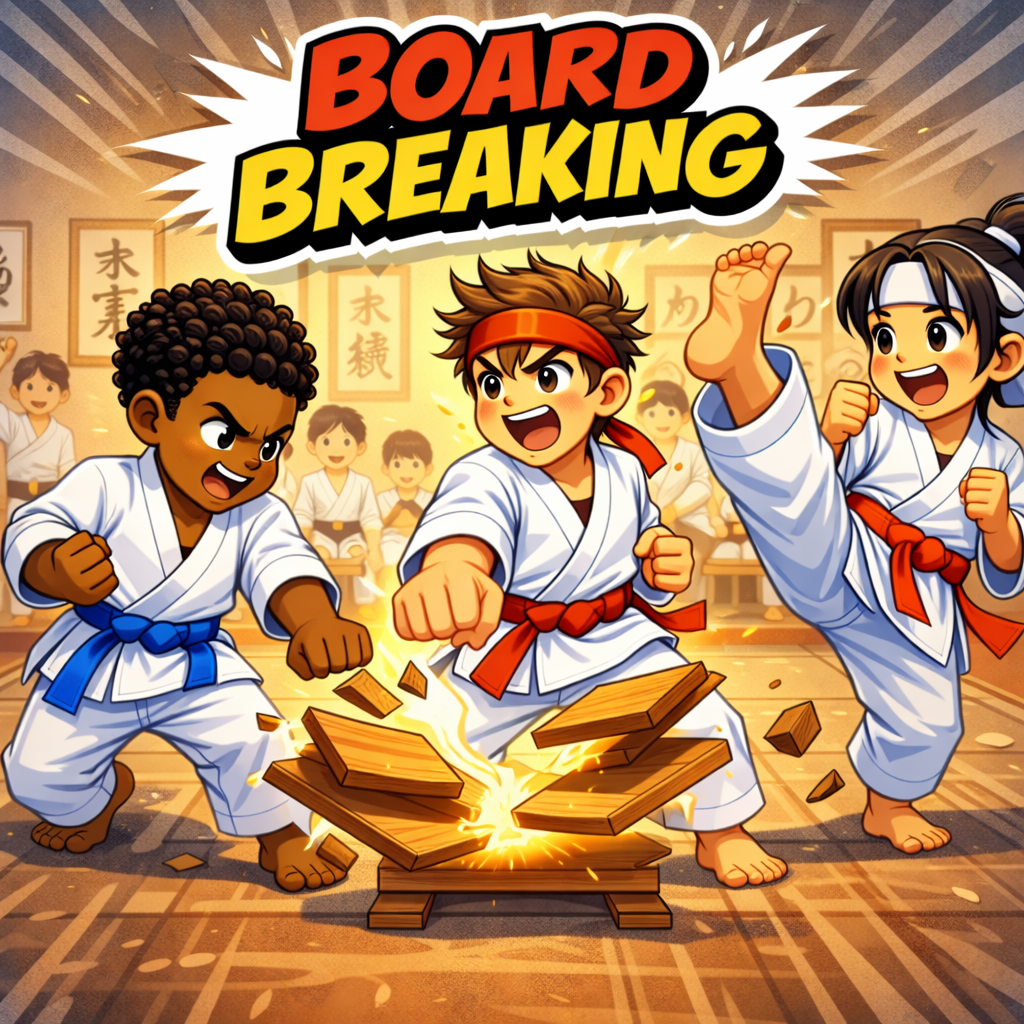
Board breaking—known traditionally as tameshiwari—is a power and precision event where martial artists break wooden boards using controlled techniques.
For tournaments like your Kumite Classic–style events, board breaking is a crowd favorite because it’s visual, dramatic, and easy for spectators to understand.
Often called “tameshiwari” in Japanese — means “test breaking.” It has deep roots in traditional martial arts training.
Okinawan Karate practitioners used breaking as a way to test power and precision.
The term tameshiwari (試し割り) literally means “test of breaking.”
It was never meant to be a trick — it was a measurement tool:
Proper alignment
Bone conditioning
Focus
Striking accuracy
Early masters would smash:
Wood boards
Roof tiles
Bricks
The goal wasn’t destruction — it was proof of correct technique.
When karate grew in popularity in the U.S. in the 1960s–1980s, breaking evolved into a:
Demonstration art
Tournament division
Crowd-pleasing spectacle
Figures from early American karate and open tournament circuits helped turn board breaking into:
Creative
Speed
Power
Musical
It became part athletic test, part performance art.
Modern tournaments typically include divisions like:
🪵 Power – Maximum boards broken with one strike
⚡ Speed – Most boards broken in a timed round
🎯 Creative – Spinning kicks, multiple techniques, combinations
🥋 Traditional – Clean, technical execution
Judges look for:
Proper technique
Control
Clean follow-through
Confidence
Safety
There’s nothing like the sound of a clean snap.
Breaking a board gives a child:
Immediate proof of strength
A visible accomplishment
A “YES!” moment
It’s tangible success.
Kids love feeling strong.
Their training works
Their body can generate force
Focus equals results
It turns discipline into something dramatic and memorable.
With proper supervision and rebreakable boards:
Risk is minimized
Technique is emphasized
Students learn alignment and control
But to them? It feels epic.
At tournaments:
Draws cheers
Builds excitement
Creates highlight moments
For kids, that spotlight moment is unforgettable.
Board breaking reinforces:
Commitment
Follow-through
Mental toughness
Overcoming fear
The hesitation before the strike mirrors life challenges.
Many instructors say:
“The board doesn’t hit back — but it does expose doubt.”
It helps children:
Push through fear
Visualize success
Commit fully
Understand that half-effort doesn’t work
It’s a physical metaphor for perseverance.
At competitive events, board breaking:
Adds variety beyond sparring and kata
Allows non-sparring athletes to shine
Showcases power divisions
Creates social media–worthy moments
It’s dramatic, photogenic, and empowering.
It isn’t about smashing wood.
It’s about:
Focus
Commitment
Confidence
Overcoming hesitation
And for kids?
It’s one of the first times they truly feel what strength and discipline can do.

© 2025 Kumite Classic Entertainment
Disclaimer | Privacy Policy
Worldwide
24/7
Pittsburgh, PA